


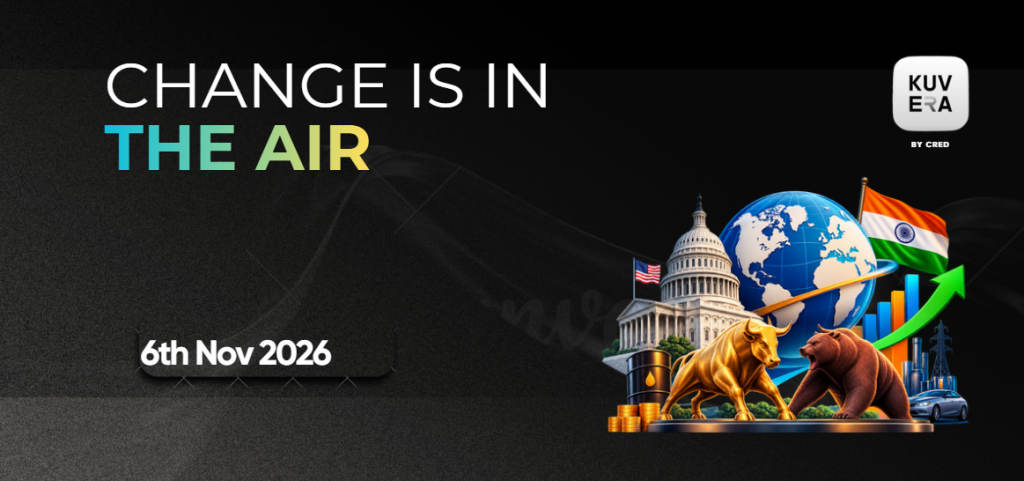
If you live in or around Delhi, you might have already started feeling the change in the air—just like every year in this season. But no, we aren’t talking about the change in the air that we are breathing. We are talking about something else.
For much of the past year and a half, ever since Donald Trump launched his trade war in early 2025, India has been on the backfoot. India’s engagement with the US has been shaped by the considerable freedom Trump has had to pursue his policy agenda, with his Republican Party controlling both chambers of Congress. The November 3 midterm elections have changed that political equation, introducing a new set of constraints on the Trump administration.
Democrats have reclaimed a majority in both chambers of Congress—the Senate and the House of Representatives. This gives them greater power to investigate the administration, scrutinise spending, influence the confirmation of presidential nominees and shape legislation on trade, immigration and foreign policy.
The results marked a broad rebuke to Trump and his Republicans, who also lost ground in states and constituencies he had carried comfortably in 2024. Economic dissatisfaction, concerns over the cost of living and government corruption, along with frustration over Trump’s Iran war, contributed to the Republican losses.
In India, the immediate reaction to the US election results was a collective sigh of relief. Stock market benchmarks Nifty and Sensex soared 2.4% on Thursday, as global oil prices cooled and foreign portfolio inflows returned.
Aside from the market reaction, the consequences for India will depend on whether greater congressional scrutiny translates into changes in US policy across three areas of particular importance: trade, immigration and energy security.
Trade has been the most immediate source of uncertainty.
In February, India and the US announced a framework for an interim trade agreement. It envisaged an 18% reciprocal tariff on specified Indian-origin goods, including textiles, leather, footwear and certain machinery. The White House also said it would remove a separate 25% tariff imposed over India’s purchases of Russian oil, citing India’s commitment to stop those purchases. The framework, however, was not a completed trade agreement.
The legal basis for the reciprocal tariffs subsequently changed. In February, the US Supreme Court ruled that Trump could not use emergency powers to impose tariffs. That month, the US imposed a separate 10% tariff on Indian goods. In September, the US passed the Graham Act to impose sanctions on Russia and Iran and levy up to 100% tariffs on major buyers of Russian oil, including India. But in October, Trump invoked a waiver, easing the threat of those tariffs.
Meanwhile, the India-US trade pact is either stalled or close to completion, depending on which official version you want to believe.
Immigration presents a different set of constraints. The Trump administration has changed the H-1B visa system and imposed a $100,000 fee for certain new petitions involving workers outside the US. Indian-born people accounted for 71% of approved H-1B petitions in fiscal 2024, making changes to the programme particularly relevant to India.
While US courts have blocked implementation of the $100,000 payment requirement and the fee is not currently being collected, the US Congress can scrutinise immigration policy and legislate on the programme.
Energy markets offered a more immediate illustration of how investors interpreted the election. Brent crude fell 8.7% on November 4 to settle at $94.62 a barrel, its lowest close since August 31. Investors appeared to be pricing in the possibility that Democratic control of Congress would increase pressure on Trump to seek an end to the Iran war. Brent was trading around $94.69 on November 5, with uncertainty over the conflict still weighing on the outlook.
For India, which depends on imports for nearly 90% of its crude oil consumption, a sustained decline in prices could ease the import bill and reduce pressure on inflation and the current account.
To be sure, Trump retains substantial executive authority and can veto legislation, with an override requiring a two-thirds majority in both chambers. Also, the election has neither resolved the Iran conflict nor removed the risks surrounding energy markets.
A Democratic Congress can investigate the Trump administration’s use of its powers, challenge its trade agenda through legislation and scrutinise the economic consequences. But it cannot by itself settle outstanding differences with India or prevent the administration from using other statutory authorities.
Washington’s political balance has shifted, but the sources of uncertainty for India remain. For investors, a change in political constraints does not necessarily mean a change in policy.


Vulnerable Links
Let’s now move on from political economy to the world of technology and cyberspace.
For years, financial institutions have worked overnight making transactions faster and connecting more parts of the financial system. Banks, lenders, payment companies and fintech platforms now rely on networks of digital interfaces to move money and process instructions. The convenience comes with a less visible risk: criminals can exploit access to systems that institutions themselves trust. Two recent developments, a major cryptocurrency theft at Binance and an AI-assisted campaign targeting Indian companies, illustrate different ways in which these vulnerabilities are being exploited.
On October 29, cryptocurrency exchange Binance suffered a security breach in which approximately $6.34 billion in digital assets were affected, according to the company. The US Federal Bureau of Investigation attributed the operation to North Korea’s TraderTraitor group.
Binance’s investigation described a multi-stage operation involving compromised employee devices and credentials. One employee downloaded tampered software after encountering an online advertisement for an AI coding tool. Another engineer was approached through what appeared to be a job interview and persuaded to download a malicious code repository. The attackers subsequently gained access to systems used by wallet developers and deployed a script to initiate unauthorised transactions.
In one four-minute window, 233.46 million XRP—a digital token—moved from five Binance hot wallets. Unauthorised transfers continued for nearly four hours. Binance said that around $2.85 billion in affected assets had been frozen or intercepted. It also said it had replenished approximately 98% of the affected assets using its own resources. Replenishment does not mean the stolen cryptocurrency was recovered.
The Indian campaign involved different methods, but raised a related concern: attackers were finding ways to use financial institutions’ own systems to transfer money.
India’s Computer Emergency Response Team (CERT-In) this week identified a hacking group it calls Crafty Falcon, describing it as an AI-assisted financial threat actor targeting banks, non-bank lenders, fintech companies and cryptocurrency exchanges. The agency named four tools used in the campaign: ARTEX, PentAGI, Cairn and CyberStrikeAI.
CERT-In said attackers were exploiting exposed servers, misconfigured systems and payment or disbursement application programming interfaces (APIs). These interfaces allow financial institutions to exchange payment instructions. By compromising them, attackers can misuse legitimate disbursement systems to route money into accounts controlled by criminals. The agency also said some institutions had been targeted again after incomplete remediation, with attacks timed around weekends and holidays to delay detection.
A separate advisory by India’s National Cybercrime Threat Analysis Unit described the attackers’ reported methods of moving money. It said funds were routed through mule accounts across banks and quickly shifted or withdrawn through IMPS and NEFT. Attackers also deleted records to obstruct investigations.
Researchers have linked at least two of the tools identified by CERT-In to China. The agency, however, has not attributed the campaign to the Chinese government or identified who operates the group.
The two cases expose vulnerabilities at different points in financial infrastructure: privileged employee access and the digital interfaces through which institutions move money. AI can make parts of an attack faster, but the underlying weaknesses remain in access controls, software and security checks.
European Gateway
Moving on to corporate developments, after establishing itself as India’s largest port operator, Adani Group is now cementing its overseas presence.
Adani Ports and Special Economic Zone this week said it is buying Dutch liquid-storage company Evos B.V. at an enterprise value of €2.56 billion ($2.88 billion). The acquisition gives Adani Ports access to eight terminals across five European countries: the Netherlands, Germany, Belgium, Spain and Malta. Evos operates in major European energy and industrial hubs, expanding Adani’s presence beyond its existing ports and logistics operations in India and South Asia.
Evos has a storage capacity of 6.3 million cubic metres and handled 37 million tonnes of throughput in 2025. Its facilities store conventional fuels and chemicals. Adani also sees an opportunity to gain exposure to the longer-term shift towards newer fuels, including sustainable aviation fuel and biofuels.
The acquisition also broadens Adani Ports’ international business. Its overseas investments include the Haifa port in Israel and operations at Colombo in Sri Lanka, but Evos adds an established network of operating storage terminals in major European energy markets.
The attraction, however, lies as much in the existing business as in its potential. Evos reported revenue of €392 million and EBITDA of €219 million in 2025, giving it an EBITDA margin of around 56%. Average commercial occupancy stood at 99%. Its long-term customer contracts, including take-or-pay arrangements, provide greater visibility over revenue by committing customers to pay for agreed capacity, subject to contractual terms.
The transaction values Evos at an enterprise value of €2.56 billion, or 11.7 times its 2025 EBITDA. The equity value is €1.18 billion. Adani Ports said the combined business would have a pro forma net debt-to-EBITDA ratio of 2.76 times, based on Adani’s FY26 and Evos’ calendar-year 2025 financials. It expects this to decline to around 2.5 times by FY27.
The acquisition, however, will be debt-funded. For investors, the question is whether the earnings and cash flows from the new business will justify the price and support the additional leverage.
A Festive Lift
Back home, India’s passenger vehicle market recorded its strongest month yet in October, with domestic wholesales crossing five lakh units for the first time. Lower prices following last year’s GST cuts may have supported demand, while festive buying and dealer stocking ahead of the peak season also lifted dispatches.
The record points to stronger momentum, but it does not yet establish how much of the increase reflects a lasting improvement in consumer demand.
Maruti Suzuki estimated that domestic passenger vehicle wholesales stood between 5.25 lakh and 5.3 lakh units in October, compared with around 4.6 lakh a year earlier.
Maruti retained its position as India’s largest passenger vehicle manufacturer, reporting domestic sales of 2,12,384 units, up from 1,76,318 in October 2025. The company said it had around 2.45 lakh pending bookings, while inventory across its dealer network stood at just 12 days. The combination points to strong order visibility and lean dealer stocks, although pending bookings are not the same as completed sales. Maruti also expected to gain about two percentage points in market share during the month.
The contest for second place was close. Tata Motors moved ahead of Mahindra & Mahindra with sales of 73,894 units, up 20.9% year-on-year, against Mahindra’s 73,338, an increase of around 2.4%. Hyundai Motor India remained fourth, with sales rising 16.7% to 62,799 units, while Kia India entered the top five with 33,462 units. Among smaller manufacturers, JSW MG Motor and Renault also reported year-on-year growth.
These figures represent wholesale dispatches from manufacturers to dealers, not retail sales to customers.
October dispatches also reflected preparations for the peak festive buying period, with Dhanteras and Diwali falling in November. Dealers may have built stocks in anticipation of higher sales, making it difficult to separate underlying demand from the seasonal stocking cycle.
The GST cuts offer a more structural reason for optimism. Lower prices can improve affordability and bring more buyers into the market, particularly in price-sensitive segments. But the extent to which this translates into sustained purchases will become clearer only when retail sales and dealer inventories are assessed alongside manufacturer dispatches.
Some experts have flagged weaker economic indicators, rising commodity costs and production constraints as factors that could affect sales in the coming months.
The important distinction is whether the increase in dispatches is matched by customer purchases and whether dealer inventories remain controlled once the festive period passes. October has set a record; how much of that momentum endures is still an open question.

Market wrap
India’s stock markets rocketed higher in the pre-Diwali week thanks to a fall in oil prices, the return of foreign flows and limited exposure to AI-related companies that sank worldwide.
The Nifty gained 8.6% and the Sensex surged 8.8% this week, marking their steepest jump since February 2021. Both indexes touched over eight-month highs. Elsewhere, stock markets across the US, South Korea, Taiwan and Japan plunged as the AI trade unravelled.
Foreign portfolio investors have bought Indian shares worth over $4.1 billion so far in November, NSDL data showed. This comes after they pulled out over $30 billion during January-October.
In the broader market, small-caps climbed 2.8% while the mid-caps jumped 5.8%.
All 16 major sectors posted gains this week. Financials soared 10.4% on foreign inflows, with heavyweights HDFC Bank and ICICI Bank surging 13.8% and 12.4%, respectively.
Non-bank lenders Shriram Finance and Bajaj Finance were the top Nifty performers, jumping 16.8% and 15.8%, respectively. Jio Financial jumped 13% while its parent, Reliance Industries, climbed 13.3% after strong quarterly results.
Auto stocks also revved up, with Mahindra & Mahindra adding 15.7%, Maruti rising 11.9% and Tata Motors Passenger Vehicles climbing 10%.
Other companies that rose at least 10% this week included UltraTech, Titan, InterGlobe Aviation, Bajaj Finserv and Tata Steel.
Power Grid Corp was the top loser, falling 1.9%. Infosys and TCS also slipped a tad, though Tech Mahindra and HCL Tech rose this week.
Earnings snapshot
- LIC Q2 net profit rises 20% from a year earlier to Rs 12,076 crore
- ONGC standalone profit jumps 57.3% to Rs 15,489 crore
- SBI net profit increases to Rs 23,038 crore from Rs 20,160 crore a year earlier
- Titan consolidated profit climbs to Rs 2,393 crore from Rs 1,120 crore year ago, tops estimates
- Britannia consolidated profit up 10.2% at Rs 721 crore, beats estimates
- Bharti Airtel consolidated profit rises to Rs 8,888 crore from Rs 6,792 crore, misses forecasts
- NSE posts 23% rise in quarterly consolidated profit to Rs 2,578 crore
- BSE consolidated profit jumps 45% to Rs 809 crore
- Samvardhana Motherson profit up 42% at Rs 1,175 crore
- LG Electronics India profit rises 26% to Rs 489 crore
- Apollo Hospitals Q2 profit up 32% to Rs 630 crore, matches forecasts
- Aurobindo Pharma consolidated profit soars 33% to Rs 1,126 crore
- Glenmark Pharma Q2 consolidated net profit slumps 56.8% to Rs 264 crore
- ITC profit drops 20% to Rs 4,137 crore as higher cigarette prices hit demand
- Cigarette maker Godfrey Phillips India’s profit sinks 37.7% to Rs 190 crore
- Lenskart consolidated net profit surges to Rs 227 crore from Rs 102 crore a year earlier
Other Headlines
- SEBI suggests scrapping long-term capital gains tax for foreign equity investors, reports Reuters
- SEBI approves IPO of Coal India unit Mahanadi Coalfields
- SEBI sets up working group to review rules for Innovators Growth Platform for startups to list
- SEBI allows mutual fund schemes to settle cash market trades on a net basis
- SEBI announces easier rules for accredited investors
- SEBI eases KYC requirements for overseas individual investors
- SEBI issues rules to let foreign investors buy REITs, InvITs units via depositary receipts
- Dabur’s global CEO Mohit Malhotra resigns after three decades with FMCG firm
- Cabinet approves incentive policy worth Rs 2,814 crore to boost lithium, nickel processing
- Cabinet approves Rs 14,500 crore programme for developing energy storage projects
- India services Purchasing Managers’ Index (PMI) hits 4-month high of 55.8 in October
That’s all for this week. Until next week, happy investing!
Interested in how we think about the markets?
Read more: Zen And The Art Of Investing
Watch here: Investing in International Markets

Start investing through a platform that brings goal planning and investing to your fingertips. Visit kuvera.in to discover Direct Plans and Fixed Deposits and start investing today. #MutualFundSahiHai #KuveraSabseSahiHai


