


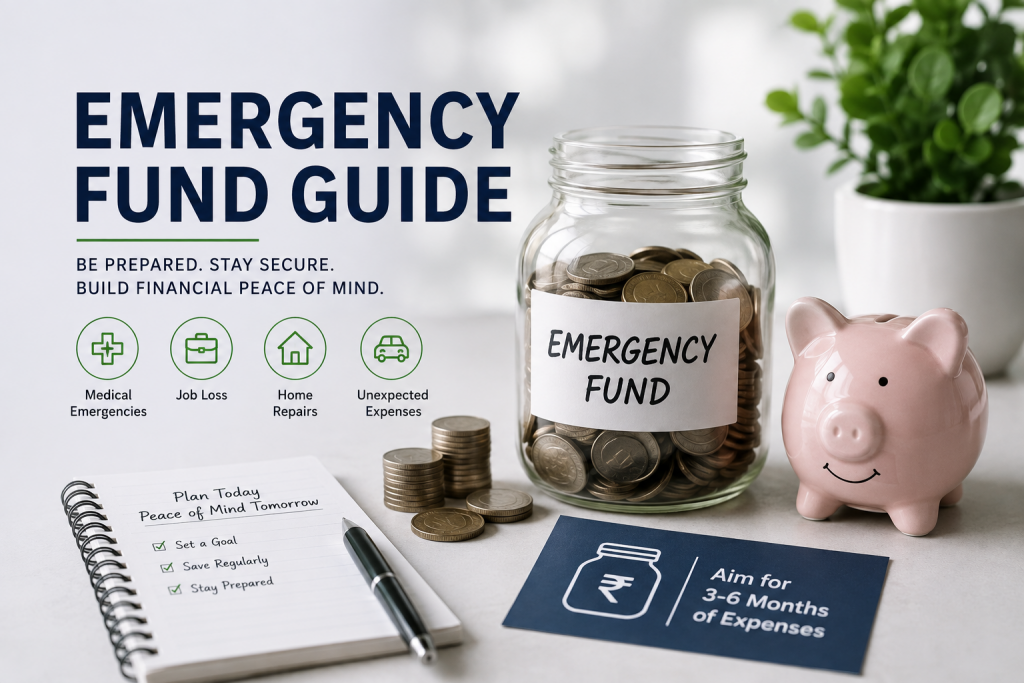
an emergency fund is not an investment. it is not a retirement corpus. it is a buffer. a pool of money set aside exclusively for genuine, unexpected financial emergencies. without one, a single job loss or medical event forces a chain of bad choices: selling equity at the wrong time, breaking fixed deposits with penalties, or borrowing at 36-48% annual interest on credit cards .
over 70% of indian households have less than one month of savings as a financial buffer . a single unexpected event can unravel months of financial progress with no safety net in place.
how much is enough. the 3-6-12 rule
the old rule of thumb was three months of expenses. that changed. with 5-6% inflation and a volatile job market, six months is now the absolute floor. if you have a family or aging parents, that moves to twelve months .
the calculation starts with essential monthly expenses. rent or home loan emi. groceries. utilities. insurance premiums. school fees. loan repayments. exclude discretionary spending like entertainment, dining out, or vacations .
for a household spending ₹40,000 a month on essentials, a six-month fund is ₹2.4 lakh. a twelve-month fund is ₹4.8 lakh . for a family with a ₹1.4 lakh monthly outgo and a sole earner, a twelve-month fund of roughly ₹17 lakh is appropriate .
| profile | target |
|---|---|
| salaried, stable sector (it, psu, banking) | 3 months |
| salaried, volatile sector (startup, sales, media) | 6 months |
| self-employed / freelancer | 6-9 months |
| single-income household with dependents | 6-12 months |
| dual-income household | 3 months |
| household with dependents + active emis | 6+ months |
include emis in the monthly expense calculation. lenders do not pause them during a job loss .
where to park the money
the emergency fund is not about returns. it is about accessibility. three buckets work well .
| layer | purpose | where to park | why |
|---|---|---|---|
| 1 – immediate | 1 month of expenses | sweep-in fd linked to savings account | available in hours, no exit load |
| 2 – short-term | 2 months of expenses | liquid mutual fund | t+1 redemption, 6.5-7% returns |
| 3 – buffer | 2-3 months of expenses | small finance bank fd or short-duration debt fund | higher yield (7.5-8.1%), held unless crisis hits |
liquid funds are regulated by sebi and historically show very low volatility. they are not capital-guaranteed like a bank deposit, but for bucket two they are appropriate since t+1 redemption covers most emergencies that are not same-day cash needs .
instant redemption up to ₹50,000 is available 24×7 via imps for liquid funds, but only for units held in statement of account mode. amounts above ₹50,000 settle on t+1 basis .
savings accounts yield 2.5-3.5%, which barely keeps pace with inflation . regular fixed deposits at 5.5-9% offer guaranteed returns and are insured up to ₹5 lakh per depositor per bank under the dicgc scheme. liquid funds offer 6.5-7.5% returns .
how to build the emergency fund without stopping sips or emis
building the fund feels impossible when there is an emi and existing sips. the solution is a structured monthly allocation .
a household with ₹60,000 take-home, ₹15,000 emi, ₹8,000 in sips, and ₹30,000 in living expenses has roughly ₹7,000 of discretionary cash. redirect ₹5,000 of that systematically into the three buckets .
| month | save | action |
|---|---|---|
| 1 | ₹5,000 | open sweep-in fd, deposit ₹5,000 |
| 2 | ₹5,000 | add ₹5,000 to sweep-in fd |
| 3 | ₹5,000 | layer one complete (₹15,000); open liquid fund |
| 4 | ₹5,000 | add ₹5,000 to liquid fund |
| 5 | ₹5,000 | add ₹5,000 to liquid fund |
| 6 | ₹5,000+ | open small finance bank fd; redirect savings to layer three |
after six months, ₹30,000 is spread across all three buckets. continuing at the same pace for another six to eight months fills bucket two fully and grows bucket three toward ₹60,000-75,000. the sips run untouched the entire time. if a bonus or increment arrives, put one quarter directly into whichever bucket is furthest from its target .
the cost of not having an emergency fund
76% of salaried indians without an emergency fund end up in a high-interest debt trap during a crisis . the emergency fund is not about growing wealth. it is about making sure a bad month does not turn into a bad decade .
the 10-5-3 rule sets realistic return expectations for indian investors. 10% from equity mutual funds, 5% from debt instruments like epf and debt funds, and 3% from savings accounts and fixed deposits . this is a guide. not a guarantee.
frequently asked questions
1. should the emergency fund include emi or just living expenses ?
include the emi in the monthly expense calculation. if household spend on living costs is ₹25,000 and the emi is ₹15,000, the monthly expense base is ₹40,000. a five-month fund would be ₹2 lakh. missing an emi has credit score consequences, so it must be part of the buffer .
2. is a liquid fund safe enough for emergency money ?
liquid funds invest in money market instruments with maturity up to 91 days. they are regulated by sebi and historically show very low volatility. they are not capital-guaranteed like a bank deposit, but for bucket two they are an appropriate choice since t+1 redemption covers most emergencies .
3. should a sip be paused to build the emergency fund faster ?
only in one scenario: if there is zero emergency savings and an imminent income risk. pausing one sip for three months to accelerate bucket one is a reasonable trade-off, because a forced personal loan at 14-18% interest costs far more than the compounding opportunity lost in three months of sip contributions .
4. does the emergency fund count toward 80c deductions ?
no. emergency fund instruments do not qualify for section 80c deductions. sips in elss funds or home loan principal repayments handle the 80c angle. the emergency fund is purely a safety net, evaluated on liquidity and accessibility .
5. how to start if the emergency fund is zero ?
phase one: save one month of expenses by cutting every non-essential for 60 days. this is the mini-fund to avoid reaching for a credit card when a small emergency hits. phase two: create a recurring deposit or a liquid fund sip. consider this an emi owed to the future self. top it up with every bonus, tax refund, or side-hustle until the six-month target is reached .


