


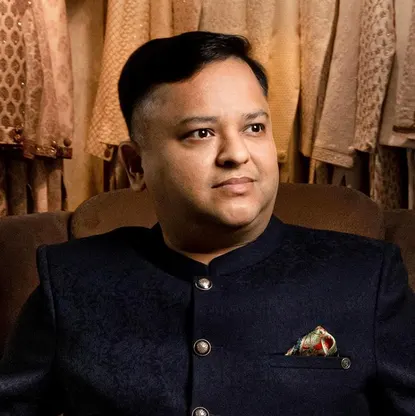
Ravi Modi’s real-time net worth sits at approximately $1.3 billion (₹12,389 crore), according to Forbes . Ravi Modi was 13 when he first stood behind the counter of his father’s clothing shop in Kolkata, learning the business the way it had been passed down through the family . Decades later, he borrowed ₹10,000 from his mother and started Vedant Fashions. That company now runs more than 670 stores across 245 cities, with 14 international stores, and his stake in it is worth roughly $1.3 billion .
The number itself is not what makes the story unusual. It is the method. No venture capital, no heavy borrowing, no exit. He built the company out of profit and then held on to it, which explains why he skipped his own listing ceremony and still lives on the outskirts of Kolkata, growing fruits and vegetables.
where ravi modi’s net worth comes from
Almost all of Ravi Modi’s wealth traces to Vedant Fashions Ltd., the parent of Manyavar, Mohey, Twamev, Mebaz, and Manthan . His stake in the company was worth roughly $1.3 billion by June 2026, making him the 2,890th richest person in the world according to Forbes .
The ownership sits largely with the Ravi Modi Family Trust, which holds 57.20% of the company . In 2023, the trust sold 9.88% of its holding, a step that lifted public ownership to 25% and met SEBI’s listing requirement .
There is one detail in the annual disclosure worth pausing on. Through the financial year ending 31 March 2026, no promoter or promoter group shares were pledged or encumbered. Promoter pledging is common enough in India’s listed companies that its absence is itself a signal.
from a ₹10,000 loan to a ₹32,000 crore market cap
The company began in 2002, after Ravi Modi had already spent years working in a clothing store and decided to go out on his own . He borrowed ₹10,000 from his mother and opened the first Manyavar store in Kolkata, selling ready-made kurta-pajama sets at around ₹200 apiece. In the earliest days he sold kurtas at a loss of ₹10 each to Vishal Mega Mart, simply because it was the one outlet that paid in cash and gave him the working capital to keep going.
What he was targeting had been left unattended. Affordable ethnic wear for weddings and festivals was either the scattered work of local tailors or high-end customisation at prices most families could not reach. The middle ground was empty.
By the time Vedant Fashions listed in 2022, its market capitalisation had crossed ₹32,000 crore . The IPO was entirely an offer for sale, with the company raising ₹3,149.19 crore . In May 2026, the company reported quarterly net profit of ₹114.3 crore, up 13.2% year-on-year, on revenue of ₹399.4 crore. The board recommended a final dividend of ₹7.75 per share for FY26 .
One feature defines how the business runs. Most of the 670-plus outlets are franchise-run rather than company-owned, which keeps the balance sheet light and debt off the books. Vedant Fashions concentrates on brand, design, and manufacturing, while franchisees fund the retail expansion.
the quiet lifestyle and the wealth philosophy
Ravi Modi’s public profile sits in contrast to how visible his brand has become. Manyavar’s advertising features Virat Kohli, Anushka Sharma, Ranveer Singh, and Alia Bhatt, yet Ravi Modi himself rarely appears on camera .
He skipped the company’s 2022 listing ceremony at the National Stock Exchange . He lives on the outskirts of Kolkata, where he grows fruits and vegetables. In 2017, he bought the Mercedes-Benz he had wanted for years, fifteen years after he first planned to buy one.
His view on wealth was captured in an interview: earning wealth without having the time to enjoy it makes little sense.
what retail investors can take from this
Bootstrapped does not mean inexperienced. Ravi Modi had been working in his father’s clothing shop since he was 13. His understanding of the trade came from decades of first-hand experience, not a business school .
A light-asset model can produce high margins. Vedant Fashions does not own most of its stores, which lets it grow without carrying the capital expenditure of retail expansion.
Zero promoter pledging is a signal. The FY26 annual disclosure shows no pledged promoter shares. For investors who track corporate governance, that is a positive marker.
Look at the business, not the share price. Vedant Fashions’ stock has moved up and down since listing in 2022. The 52-week range spans from a high of ₹849.55 to a low of ₹329.65 . The company itself has kept generating cash and growing profit.
Ravi Modi is 49 . His wife Shilpi sits on the board, and his son Vedant serves as the company’s chief revenue officer . The next phase of growth may come from newer brands like Mohey and Twamev, which are expanding in the women’s and premium segments.
For retail investors, Vedant Fashions stock is publicly traded. But the way Ravi Modi accumulated his wealth, growing through profit rather than outside capital, holding a large stake, and avoiding leverage, offers a set of principles worth studying. The principles outlast any single stock.
Frequently Asked Questions
1. What is Ravi Modi’s net worth?
Forbes estimates his real-time net worth at approximately $1.3 billion (₹12,389 crore) as of June 2026 . The figure fluctuates with Vedant Fashions’ share price.
2. How much of Vedant Fashions does Ravi Modi own?
The Ravi Modi Family Trust holds 57.20% of the company . In 2023, the trust sold 9.88% of its holding to meet SEBI’s minimum public shareholding requirement .
3. How was Vedant Fashions founded?
Ravi Modi borrowed ₹10,000 from his mother in 2002 and opened the first Manyavar store in Kolkata . The first products were ready-made kurta-pajama sets priced at around ₹200.
4. How many brands does Vedant Fashions own?
The company’s brands include Manyavar (wedding and festive menswear), Mohey (womenswear), Twamev (premium), Mebaz, and Manthan .


