


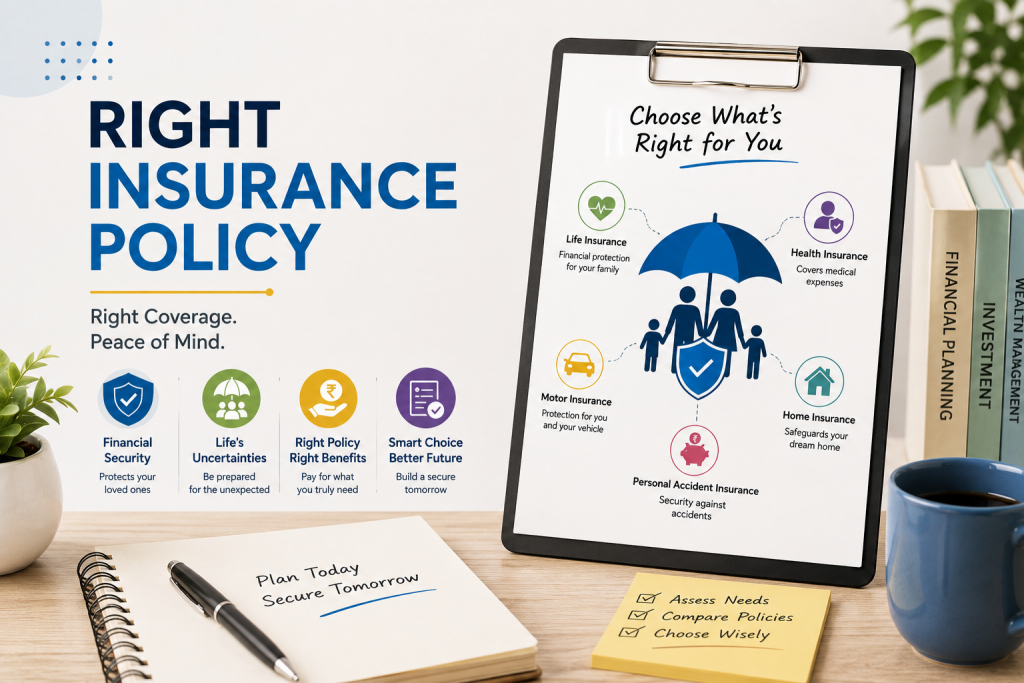
insurance is not a one-size-fits-all product. the right policy depends on age, income, dependents, lifestyle, and health. comparing policies can reduce premiums significantly-buyers who compare health plans pay at least 20% less on average, motor buyers save 15-20%, and term insurance buyers can cut first-year premiums by nearly 30% .
the goal is not to find the cheapest policy. the goal is to find the one that provides adequate protection without straining the budget.
start with the purpose. what is being protected
insurance products are specialised tools for specific scenarios . the first question is not which policy is cheaper. it is what risk needs to be covered.
term insurance. replaces income if the policyholder dies during the working years. the nominee receives a lump sum. this money can cover daily expenses, loan repayments, children’s education, and other financial obligations .
health insurance. covers medical expenses from illness, accident, or hospitalisation. it pays for hospital bills, doctor consultations, diagnostic tests, and treatments. it can be availed as cashless treatment at network hospitals .
personal accident cover. provides a lump sum for permanent disability from an accident. it often includes a weekly income benefit if the policyholder is temporarily bedridden .
critical illness cover. pays a lump sum upon diagnosis of a life-threatening disease like cancer, kidney failure, or stroke. this money can be used for treatment, lifestyle adjustments, or clearing debts .
combining term insurance and health insurance is not optional. it is necessary . term insurance protects the family when the policyholder is not around. health insurance protects the policyholder during a medical emergency. neither replaces the other.
calculate the sum assured
the coverage amount should not be a guess. it should be calculated.
term insurance. the old rule of thumb—10 times annual income—is now considered the absolute floor . a more robust approach is the income replacement method. if the annual income is ₹12 lakh and the remaining working years are 25, the family would lose ₹3 crore in potential earnings. adjusted for inflation (around 6% annually), a cover of 15 to 20 times annual income is the modern benchmark .
outstanding liabilities like home loan and car loan should be added to this sum assured . financial experts recommend a coverage amount of 15-20 times annual income .
health insurance. a ₹10 lakh cover is marketed as sufficient, but medical inflation in india is 12-13% annually . for older adults in metros, ₹15-25 lakh coverage may be more appropriate . a base policy with a super top-up can be a practical alternative .
compare policies. premium is not the only factor
premiums vary widely across insurers. a ₹10 lakh family floater in delhi can cost between ₹773 and ₹2,426 per month . a 30-year-old non-smoker seeking ₹1 crore term cover can get quotes ranging from ₹635 to ₹958 per month .
comparison behaviour is increasing. nearly 75% of health buyers now compare at least three plans . just over 40% of term buyers compare three or more plans, up from 32% in 2023 .
but price is one factor among several .
what to check beyond the premium
claim settlement ratio (csr). the percentage of death claims a company approves. the industry’s four-year average csr is 98.66% . a four-year average above 99% is preferable . this indicates the insurer has robust underwriting and claim assessment processes.
amount settlement ratio (asr). csr tells how many claims get approved. asr tells how much money actually gets paid. a company with 99% csr but 80% asr means families receive only 80% of the sum assured on average . look for a four-year average asr above 95% .
solvency ratio. the ratio of available assets to liabilities. irdai mandates a minimum of 1.5 . a ratio above 1.80 provides a meaningful buffer and indicates financial strength to weather adverse conditions .
exclusions. every policy has exclusions. term insurance excludes certain causes of death. health insurance excludes pre-existing conditions for a waiting period, cosmetic treatments, and self-inflicted damage . reviewing exclusions before purchase prevents claim disputes later.
waiting periods. health insurance has initial waiting periods before coverage begins for certain illnesses . pre-existing diseases typically have a waiting period. some specific surgeries have time-based restrictions.
network hospitals and garages. for health insurance, the cashless hospital network determines how smoothly claims are processed . for motor insurance, the garage network affects repair convenience.
riders and add-ons. term insurance offers add-ons like critical illness, accidental death benefit, and waiver of premium . health insurance offers riders like critical illness and personal accident. only add what is genuinely needed .
what to avoid
bundled products. agents often push unit-linked insurance plans or endowment plans as “investment + insurance.” these typically offer a low sum assured (usually only 10 times the premium) and high commissions. for a young earner, these are a poor fit . buying a cheap term plan and investing the rest in mutual funds is more effective.
hiding information. false or misleading information on the proposal form can lead to claim disputes . disclosure of smoking, diabetes, previous surgeries, and existing illnesses is necessary.
ignoring the free-look period. life insurance policies can be cancelled within 15 days of receiving the policy bond if the terms do not match the agreement. for policies bought online, the free-look period is 30 days .
frequently asked questions
1. how much term insurance cover is enough ?
a minimum of 15-20 times annual income, plus outstanding liabilities . the income replacement method provides a more accurate estimate .
2. is a ₹10 lakh health insurance policy sufficient ?
it may be a practical base, but medical inflation in india is 12-13% annually. for older adults in metros, ₹15-25 lakh coverage may be more appropriate .
3. what is the difference between term insurance and health insurance ?
term insurance pays a lump sum to the family if the policyholder dies. health insurance covers medical expenses during hospitalisation .
4. why do premiums vary so much across insurers ?
premiums vary because insurers assess risk differently and offer different coverage, add-ons, deductibles, co-payment clauses, and claim-related features .
5. what is the free-look period in insurance ?
a period during which the policyholder can cancel the policy if the terms do not match the agreement. 15 days for policies bought offline. 30 days for policies bought online .


