


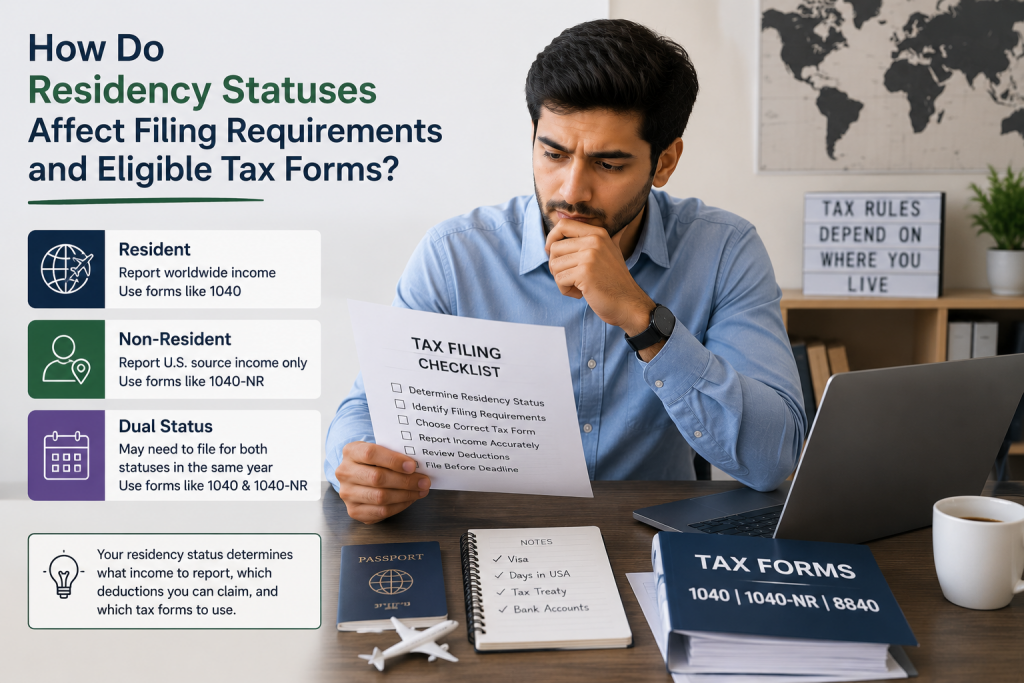
an individual’s tax liability in india depends on residency status. the status determines what income is taxed. and which itr form applies.
the income tax act, 2025, effective from april 1, 2026, retains the core residency tests . the rules for determining residency have not materially changed .
the three residency statuses
indian tax law classifies individuals into three categories .
resident and ordinarily resident (ror). global income is taxable. this includes income earned and received anywhere in the world .
resident but not ordinarily resident (rnor). only income that accrues or arises in india is taxable. foreign income is generally not taxable unless it is received in india or from a business controlled in india .
non-resident (nr). only income that accrues or arises in india is taxable. foreign income is not taxable .
how residency is determined
residency depends on physical presence in india. two basic conditions apply .
condition 1. presence in india for 182 days or more in the tax year.
condition 2. presence in india for 60 days or more in the tax year, and 365 days or more in the preceding four years.
if either condition is met, the individual is a resident. if neither is met, the individual is a non-resident .
exceptions to condition 2. for indian citizens leaving india for employment, or as crew on an indian ship, the 60-day period is extended to 182 days . for indian citizens or persons of indian origin visiting india, the 60-day period is extended to 182 days. if total income from indian sources exceeds ₹15 lakh, the period is 120 days .
resident vs rnor. the additional conditions
once an individual qualifies as a resident, further classification depends on two additional conditions .
condition a. resident in india in at least 2 out of the 10 preceding tax years.
condition b. stay in india of 729 days or more in the 7 preceding tax years.
if both conditions are met, the individual is ror. if either condition is not met, the individual is rnor .
filing requirements. itr forms
the itr form depends on residency status and income type .
itr-1 (sahaj). only for resident individuals. total income up to ₹50 lakh. income from salary, pension, one house property, and specified other sources. cannot be used by nris, rnors, or individuals with capital gains, foreign income, or business income .
itr-2. for individuals and hufs without business income. includes salary, capital gains, foreign income, multiple house properties. required for nris, rnors, and residents with foreign assets or income .
itr-3. for individuals and hufs with business or professional income. freelancers, traders, consultants, and proprietors .
itr-4 (sugam). only for resident individuals. presumptive taxation under sections 44ad, 44ada, or 44ae. total income up to ₹50 lakh. cannot be used by nris or rnors .
quick comparison table
| status | income taxed | itr form |
|---|---|---|
| ror | global income | itr-2 or itr-3 |
| rnor | india-sourced income only | itr-2 or itr-3 |
| nr | india-sourced income only | itr-2 or itr-3 |
special rules for nris.
concessional tax regime. special provisions under sections 213-217 of the new act (previously 115d-115i) allow concessional tax rates on investment income and long-term capital gains .
tds rates. higher tds applies to nri income. fixed deposits, rental income, and capital gains are subject to different rates .
foreign tax credit. form 67 must be filed before the itr due date to claim credit for taxes paid abroad . form 10f and tax residency certificate are required for claiming treaty benefits .
FAQs About residency status and tax filing
1. what is the difference between ror, rnor, and nr
ror pays tax on global income. rnor and nr pay tax only on india-sourced income. rnor is a transitional status for returning residents .
2. which itr form should an nri file
itr-2 or itr-3. itr-1 and itr-4 cannot be used by nris or rnors .
3. can an nri be a resident for tax purposes
yes. if the individual stays in india for 182 days or more, or meets the 60+365 day test, they become resident .
4. what is the 120-day rule for visiting indians
for indian citizens or pios visiting india, the 60-day period extends to 120 days if total indian income exceeds ₹15 lakh .
5. how to claim foreign tax credit
file form 67 before the itr due date. attach form 10f and tax residency certificate. keep foreign tax payment proof .


