


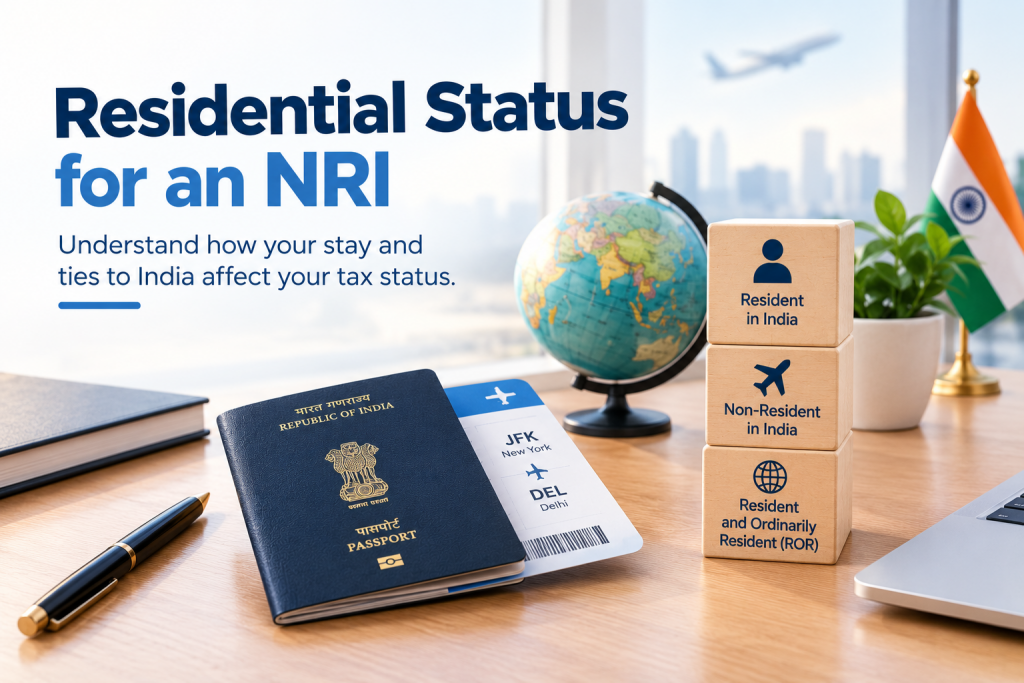
residential status for tax purposes is not about citizenship or passport. it is about days spent in india during the financial year. that is the only thing that matters.
the rules are in section 6 of the income tax act. the income tax act, 2025 replaced the old 1961 act from april 1, 2026. but the basic day-count tests did not change.
the two tests for residency
there are two tests. meet either one and you are a resident.
the first test. you stayed in india for 182 days or more during the financial year.
the second test. you stayed in india for 60 days or more during the financial year. and you stayed 365 days or more across the four years before that.
fail both tests and you are a non-resident.
the second test catches frequent visitors. someone who spends two months in india every year for four years can become a resident. even if they never cross 182 days in a single year.
deemed residency for indian citizens
there is also a deemed residency rule. section 6(1a) of the 1961 act, now section 6(7) of the 2025 act.
an indian citizen is deemed a resident if two conditions are met. total income from indian sources exceeds ₹15 lakh in the year. and the individual is not liable to pay tax in any other country because of domicile, residence, or similar criteria.
this targets indian citizens living in zero-tax places like the uae, bahrain, qatar, and monaco. they can be treated as residents even if they spend zero days in india.
but they are classified as rnor. under rnor status, foreign income is generally not taxed in india. only indian income gets taxed.
the ₹15 lakh threshold is not high. one property sale with capital gains above ₹15 lakh can trigger it. a decent dividend portfolio can cross it too.
the uae advantage and the bahrain problem
uae residents have one advantage. the india-uae dtaa treats someone as a uae tax resident if they spend 183 days there in a calendar year. this creates dual residency. the treaty tie-breaker tests then apply. most long-term uae residents win because their permanent home and centre of vital interests are in the uae.
for people in oman, bahrain, and similar countries, the situation is different. those countries tax companies but not individuals. so indian citizens there cannot qualify as tax residents under the dtaa. without that qualification, they cannot access treaty benefits.
rnor vs ror vs non-resident
once residency is confirmed, the next step is checking rnor vs ror.
rnor applies if you have been a non-resident in nine out of the ten previous years. or if you stayed in india for 729 days or less in the seven previous years.
if both conditions fail, you are ror.
ror pays tax on global income. rnor and non-resident pay tax only on india-sourced income.
here is how the tax scope differs.
| nature of income | ror | rnor | non-resident |
|---|---|---|---|
| income accruing in india | taxed | taxed | taxed |
| income received in india | taxed | taxed | taxed |
| foreign income from business controlled in india | taxed | taxed | not taxed |
| foreign income with no india connection | taxed | not taxed | not taxed |
how to count days in india
when counting days, both arrival and departure dates count. someone who arrives on january 1 and leaves on january 10 has spent ten days in india. not nine.
weekends and holidays count. continuous presence is not required. multiple visits add up.
fema status vs income tax status
fema status and income tax status are two different things. do not mix them.
fema looks at intention to stay outside india. income tax looks at days spent in india.
you can be non-resident under fema but resident for tax purposes. the reverse is also possible. bank account types like nre and nro follow fema rules. not tax rules.
frequently asked questions
1. is residential status based on citizenship or days in india
days in india. citizenship and passport do not matter.
2. what is the 120-day rule
indian citizens and persons of indian origin visiting india with indian income above ₹15 lakh are treated as resident if stay exceeds 120 days and they have stayed 365 days or more in the four preceding years. classified as rnor.
3. what is deemed residency
indian citizens with indian income above ₹15 lakh who are not liable to tax in any other country are deemed residents. classified as rnor. targets zero-tax jurisdictions.
4. does the uae dtaa help
yes. india-uae dtaa treats someone as uae tax resident after 183 days. creates dual residency. treaty tie-breaker usually resolves in uae’s favour.
5. how are days counted
both arrival and departure dates count. weekends and holidays count. multiple visits add up.


