


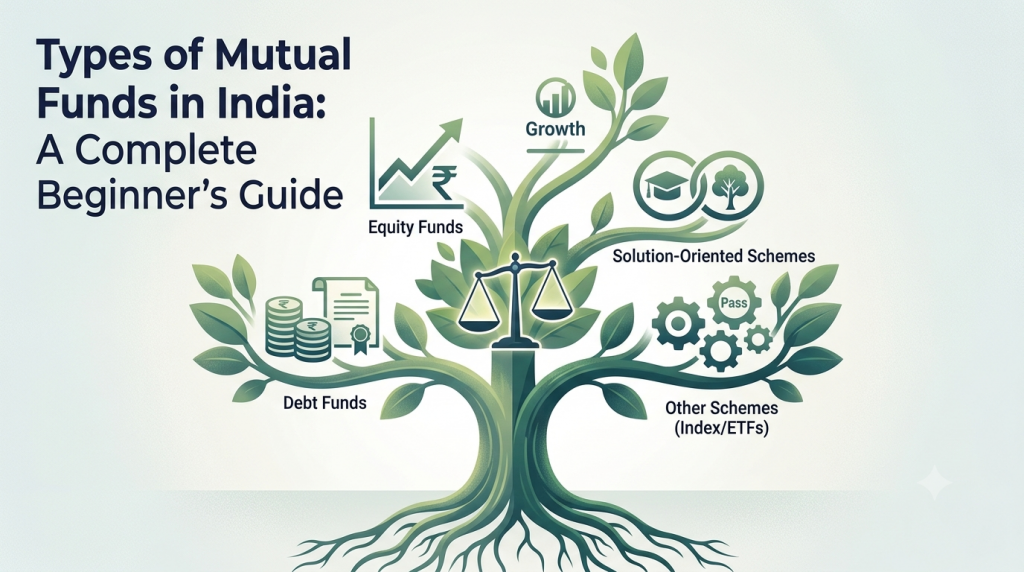
mutual funds are one of the most common ways indians invest. but the number of options can be overwhelming. the securities and exchange board of india introduced a standard classification in 2017 to bring uniformity across schemes . this means the fund type is no longer a mystery.
here is a breakdown of the main categories. the goal is to understand where a fund sits on the risk-return spectrum before committing money.
the five main categories
sebi has broadly classified mutual fund schemes into five groups :
- equity schemes – invest primarily in shares of companies
- debt schemes – invest in fixed-income instruments like bonds and treasury bills
- hybrid schemes – invest in a mix of equity and debt
- solution-oriented schemes – designed for specific goals like retirement or children’s education
- other schemes – includes index funds, etfs, and fund of fund.
equity funds: for long-term growth
equity funds invest in company shares. they aim for capital appreciation over the long term and are suitable for investors with a higher risk tolerance .
here are the sub-categories within equity funds:
| fund type | minimum investment in equity | what it means |
| large cap fund | 80% in top 100 companies | invests in well-established, stable companies. lower risk among equity funds . |
| mid cap fund | 65% in companies ranked 101-250 | invests in medium-sized companies with higher growth potential but also higher volatility . |
| small cap fund | 65% in companies ranked 251 and below | invests in smaller companies. high growth potential, but very high risk and volatility . |
| flexi cap fund | 65% in equities, no fixed allocation | fund manager can invest across large, mid, and small caps based on market conditions . |
| multi cap fund | 75% in equities, with at least 25% each in large, mid, and small caps | diversified across company sizes, spreading risk . |
| sectoral / thematic fund | 80% in one sector or theme | invests in a specific industry like banking or it. very high risk due to lack of diversification . |
| elss (tax-saving fund) | 80% in equities | offers tax benefits under section 80c with a 3-year lock-in period . |
debt funds: for stability and income
debt funds invest in fixed-income securities like government bonds, corporate bonds, and treasury bills. they are less risky than equity funds and aim to provide regular income and capital preservation .
here is a look at the key debt fund types:
| fund type | investment focus | what it means |
| overnight fund | securities with 1-day maturity | very short-term parking of money. lowest risk . |
| liquid fund | securities with up to 91 days maturity | for short-term needs. better returns than a savings account with high liquidity . |
| ultra short duration fund | macaulay duration of 3-6 months | suitable for parking money for a few months . |
| short duration fund | macaulay duration of 1-3 years | for short-term goals (2-3 years) . |
| medium duration fund | macaulay duration of 3-4 years | for a medium-term investment horizon . |
| gilt fund | minimum 80% in government securities | negligible credit risk (sovereign risk). returns are sensitive to interest rate changes . |
| corporate bond fund | minimum 80% in aa+ and higher-rated corporate bonds | aims for relatively stable returns from high-quality papers . |
hybrid funds: a balance of growth and stability
hybrid funds invest in a mix of equity and debt. they aim to provide growth potential from equities and stability from debt within a single portfolio .
the main hybrid fund types are:
| fund type | equity allocation | what it means |
| aggressive hybrid fund | 65% to 80% | higher growth orientation. suitable for investors with moderate to high risk tolerance . |
| balanced hybrid fund | 40% to 60% | seeks a balanced exposure to both equity and debt. no arbitrage is permitted . |
| conservative hybrid fund | 10% to 25% | prioritises capital preservation and income. limited equity exposure . |
| multi asset allocation fund | at least 10% each in 3 asset classes | offers wider diversification beyond equity and debt. can include gold or other assets . |
| dynamic asset allocation / balanced advantage fund | 0% to 100% | allocation between equity and debt changes dynamically based on market conditions . |
| arbitrage fund | at least 65% in equity using arbitrage strategy | low-risk strategy that aims to profit from price differences in cash and derivatives markets . |
solution-oriented schemes and other funds
solution-oriented schemes are designed for specific life goals. these funds have a mandatory lock-in period to encourage long-term savings .
retirement fund: lock-in of at least 5 years, or till retirement age. aims to build a retirement corpus .
children’s fund: lock-in of at least 5 years, or till the child reaches the age of majority. aims to create a corpus for future expenses like education or marriage .
other schemes include passively managed funds:
index fund / etf: invests at least 95% in securities of a specific index. aims to replicate the performance of a benchmark like the nifty 50 or sensex .
fund of funds: invests in other mutual funds rather than directly in stocks or bonds .
choosing the right fund
the right fund depends on two things. the investment horizon and the risk appetite.
for a beginner, starting with a flexi cap fund or a balanced hybrid fund is a common approach. these funds offer diversification and have a track record of delivering returns across market cycles . many fund houses now allow investors to start with amounts as low as ₹100, making it accessible to almost everyone .
FAQs
1. what is the difference between a regular and a direct mutual fund ?
a direct fund has no intermediary commission. the expense ratio is lower. the regular plan includes a distributor commission. the portfolio and fund manager are identical .
2. which mutual fund is best for a beginner ?
a flexi cap fund or a balanced hybrid fund is often recommended. they offer diversification and a balanced risk-return profile.
3. how much money do i need to start a sip ?
many funds allow sips starting from ₹500. some have introduced micro-sip options starting as low as ₹100 .
4. what is the lock-in period for elss funds ?
elss funds have a mandatory lock-in period of 3 years .
5. are debt funds risk-free ?
no. debt funds carry credit risk and interest rate risk. gilt funds have negligible credit risk but are still sensitive to interest rate changes .


