


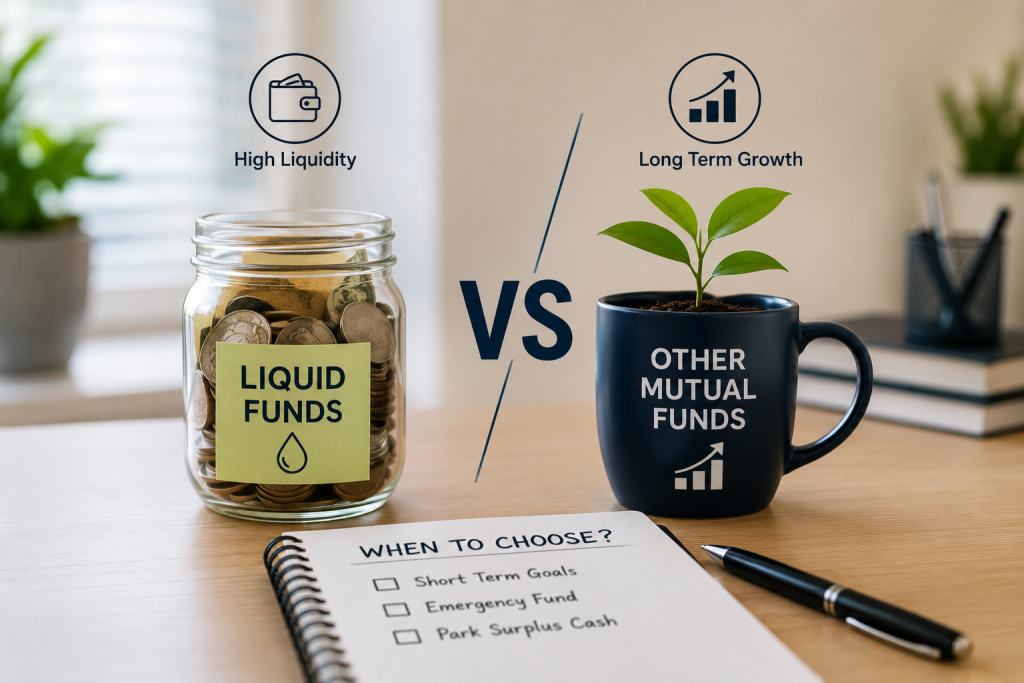
not all mutual funds are the same. liquid funds are a specific category with distinct features.
they invest in ultra-short-term debt instruments. maturities up to 91 days. treasury bills. commercial papers. certificates of deposit . the goal is capital preservation with quick access. not high growth .
this sets them apart from other mutual fund categories. the differences matter for choosing the right option.
liquid funds vs equity funds. the core difference
equity funds invest in company shares. returns depend on stock market performance. higher risk. higher potential returns . long-term horizons suit them better .
liquid funds invest in short-term debt. returns come from interest accrual. not from price movements. nav is relatively stable. minor fluctuations can occur due to daily mark-to-market valuation .
key differences.
| factor | liquid funds | equity funds |
|---|---|---|
| investment type | short-term debt instruments | company shares |
| risk level | low | high |
| return potential | modest (6-7%) | higher (10-15%+ over long term) |
| liquidity | t+1 redemption, instant up to limits | t+2 or t+3 |
| best for | short-term needs, emergency corpus | long-term wealth creation |
liquid funds vs other debt funds
liquid funds are the shortest-duration category in the debt fund universe . other debt funds hold securities with longer maturities. higher returns are possible. more volatility .
liquid funds vs ultra short-duration funds.
ultra short-duration funds have a macaulay duration of 3 to 6 months . liquid funds have maturities up to 91 days .
| factor | liquid funds | ultra short-duration funds |
|---|---|---|
| maturity | up to 91 days | 3-6 months |
| liquidity | higher (t+1, instant) | lower (t+1) |
| returns | lower | slightly higher |
| risk | lower | marginally higher |
liquid funds vs arbitrage funds.
arbitrage funds profit from price differences between cash and futures markets. they are classified as equity funds for tax purposes .
| factor | liquid funds | arbitrage funds |
|---|---|---|
| investment strategy | interest income from debt | market-neutral arbitrage |
| risk | low | low (hedged) |
| taxation | slab rate | equity tax rate (ltcg 12.5%) |
| best for | very short-term, lower tax bracket | 3+ months, higher tax bracket |
when liquid funds make sense
one. emergency corpus. liquid funds are commonly used for emergency funds . returns are higher than savings accounts. access is quick. a practical allocation strategy involves splitting the emergency corpus: 60-70% in liquid funds and 30-40% in savings accounts or fixed deposits .
two. short-term goals under 3 years. goals with timelines under three years cannot afford equity volatility. liquid funds preserve capital while generating returns modestly ahead of inflation . a planned home down payment in 18 months. a car purchase in two years. funding a wedding in 30 months.
three. parking surplus cash temporarily. liquid funds serve as a holding area for money awaiting deployment. annual bonuses. proceeds from asset sales. profits booked from equity investments. or any windfall requiring a decision on final allocation .
four. systematic transfer plans. placing a lump sum in a liquid fund and setting up a monthly stp into an equity fund provides rupee-cost averaging. the remaining amount earns returns instead of sitting idle .
when other funds make sense
equity funds for long-term goals. retirement. children’s education. 7+ years.
arbitrage funds for 3+ months in higher tax brackets. better post-tax returns .
ultra short-duration funds for 3-6 month goals. slightly higher returns than liquid funds .
longer-duration debt funds for goals 1-3 years away. higher returns than liquid funds. moderate risk.
FAQs About the Liquid Funds vs Other Mutual Funds
1. are liquid funds safer than equity funds
liquid funds carry much lower market risk than equity funds. they are not risk-free. credit events in the underlying portfolio can affect nav .
2. how quickly can money be accessed
standard redemptions settle in one business day (t+1). some schemes offer instant redemption up to ₹50,000 through imps .
3. how are liquid funds taxed
for investments made on or after april 1, 2023, gains are taxed at the applicable income tax slab rate. no ltcg benefit. no indexation .
4. what is the minimum investment amount
most liquid funds accept investments starting from ₹500. some allow ₹100 for sips.
5. can liquid funds be used for an emergency corpus
yes. liquid funds are commonly used for emergency funds. the key consideration is that nav can fluctuate slightly and capital is not guaranteed . diversification across two amcs reduces dependency on a single fund house .


