


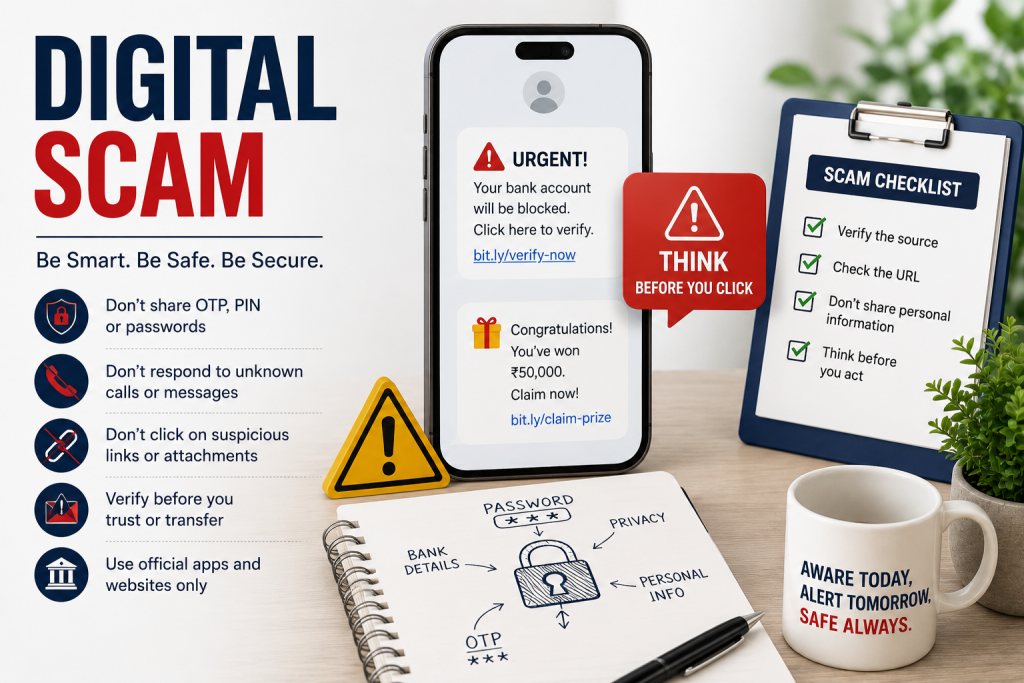
in 2024 alone, reported cases of “digital arrest” scams in india more than tripled to 1,23,672. the amount defrauded surged over 21 times to ₹1,935.51 crore. by november 2025, the supreme court observed that more than ₹3,000 crore had been siphoned off through these scams, with victims largely from the elderly population.
digital arrest has no basis in law. no law enforcement agency conducts investigations or arrests through phone or video calls.
what is a digital arrest scam
digital arrest is a form of cybercrime where fraudsters impersonate law enforcement officials. police. cbi. enforcement directorate. customs. income tax officers. they use threats of arrest, frozen bank accounts, and criminal prosecution to coerce victims into paying money.
the scam has no basis in law. no law enforcement agency conducts investigations or arrests through phone or video calls.
how the scam works
the call. the scam begins with a phone call, email, or whatsapp message. the caller poses as a government official — telecom regulatory authority, police officer, or cbi agent. the victim is told they are under investigation for serious crimes: money laundering, drug trafficking, terror funding, or identity theft.
the evidence. to add credibility, scammers send forged documents. court orders. arrest warrants. papers bearing government seals. they may use fake videos, doctored arrest warrants, or spoofed phone numbers that appear official.
the isolation. victims are placed under “digital arrest” — forced to remain on continuous video or audio calls, often for hours or days. they are cut off from family and friends. they are threatened with immediate arrest if they disconnect or contact anyone.
the demand. the victim is instructed not to involve family or lawyers. they are told they must transfer money to “verify” their bank accounts, “clear their name,” or pay a “security deposit.” the scammers may even use fake supreme court hearings with actors posing as judges and prosecutors.
the disappearance. once the money is transferred, the scammers vanish. the victim realises they have been deceived only after trying to verify the situation with actual authorities.
the scale of the problem
national level. between 2022 and may 2026, 2,97,727 complaints and losses of ₹4,057.7 crore were recorded. complaints rose from 39,925 in 2022 to a peak of 1,23,672 in 2024. in the first five months of 2026, 15,215 complaints were filed, accounting for ₹481.1 crore in losses.
high-value cases. delhi recorded 376 high-value cybercrime cases involving cheating of more than ₹50 lakh each in 2025. “digital arrest” scams accounted for 57 of these cases.
individual cases. an 82-year-old was defrauded of ₹22.92 crore. a delhi couple lost nearly ₹15 crore. a 78-year-old former banker lost ₹23 crore. an 86-year-old retired bank manager lost ₹1.3 crore. a 62-year-old lost ₹39.40 lakh and a 52-year-old lost ₹60 lakh in separate incidents in bengaluru.
state-level. digital arrests alone cost chandigarh residents ₹10.37 crore in the first eight months of 2025.
international networks. the delhi police busted a syndicate linked to taiwan, cambodia, pakistan, and nepal that defrauded victims of nearly ₹100 crore. the calls were routed from abroad but made to appear as domestic indian numbers through illegal sim box installations. thousands of young indians have been trafficked to cambodia and forced to extort people.
why the scam works
fear and authority. scammers deliberately use a formula of authority, urgency, and secrecy. when someone is told their name has surfaced in an illegal transaction and an arrest warrant has been issued, the first instinct is to protect their reputation.
psychological pressure. victims are isolated and kept under continuous surveillance. this prevents them from thinking clearly or reaching out for help. the “deer-in-the-headlights” syndrome kicks in — rational brain freezes, emotional brain takes over.
sophisticated staging. fraudsters replicate bureaucratic procedures in striking detail. fake case numbers. forged warrants. spoofed official phone numbers. uniforms. badges. increasingly, ai-generated deepfake videos of officials.
data leaks. scammers seem to know everything about the victim. address. aadhaar number. pan. tax account details. the massive repository of personal data makes the scam more convincing.
what to do when such a call is received
first. disconnect immediately. do not engage. do not argue. do not explain.
second. do not share any personal or financial details. never share otp, bank account numbers, or passwords.
third. do not transfer any money. no legitimate investigation requires a “security deposit” or “verification payment.”
fourth. report the call to the national cybercrime helpline 1930 or report at https://www.cybercrime.gov.in.
fifth. report the mobile number on the sanchar saathi app. if three people report the same number, it is automatically blocked. if 10 people report, the imei is blocked.
what to do if money has already been lost
immediately report. call 1930 or report online at cybercrime.gov.in within 5 days. the faster the matter is reported, the better the chances of recovery.
file an fir. approach the local police station or cybercrime cell. provide all details: call records, transaction receipts, bank account numbers, and communication history.
contact the bank. request the bank to freeze the recipient account immediately. provide the complaint acknowledgement.
preserve evidence. save call logs, whatsapp messages, screenshots of video calls, and transaction confirmations.
do not suffer in silence. victims often hesitate to report because of fear of social stigma or reputational harm. this enables scammers to continue. awareness and reporting are the first lines of defence.
what authorities are doing
supreme court. the court has directed cbi to act as the primary investigating agency and granted it a “free hand” under the prevention of corruption act in cases where mule accounts are used. it has ordered a pan-india rollout of rbi’s standard operating procedure, enabling banks to place temporary debit holds on suspicious accounts. the court also asked the rbi, dot, and other stakeholders to develop a framework for compensating victims.
cbi. under operation chakra-vi, cbi conducted searches at 80 locations across 16 states and arrested two accused involved in over 200 cases of digital arrest scams. they also unearthed a fraudulent website deceptively similar to the official website of the supreme court of india.
rbi. the rbi has proposed a ‘kill switch’ mechanism allowing users to immediately stop all financial transactions from their accounts when they suspect fraud. it has also proposed a ‘switch on’ and ‘switch off’ facility for all digital payment modes.
delhi police. busted an international cybercrime syndicate that defrauded victims of nearly ₹100 crore using fake ats calls and illegal sim boxes.
frequently asked questions
1. what is a digital arrest scam ?
a digital arrest scam is a cybercrime where fraudsters impersonate law enforcement officials, use threats of arrest and criminal prosecution, and coerce victims into transferring money. “digital arrest” has no legal basis no law enforcement agency arrests or investigates through phone calls.
2. how can a digital arrest scam call be identified ?
calls from scammers often contain threats of immediate arrest, demands for money to “clear your name,” instructions to stay on video calls continuously, pressure to not contact family or lawyers, and requests for otp or bank details. real law enforcement does not operate this way.
3. what should be done when a digital arrest scam call is received ?
disconnect immediately. do not share any personal or financial details. do not transfer money. report the call to 1930 or cybercrime.gov.in. report the mobile number on the sanchar saathi app.
4. can lost money be recovered after a scam ?
report immediately. call 1930 or report online within 5 days. the faster the report, the better the chances of recovery. the supreme court has also directed authorities to develop a framework for compensating victims.
5. who is most vulnerable to digital arrest scams ?
elderly citizens, senior citizens, and retired individuals are the most targeted. however, highly educated professionals, students, and even elected representatives have been targeted. anyone can be a victim.


