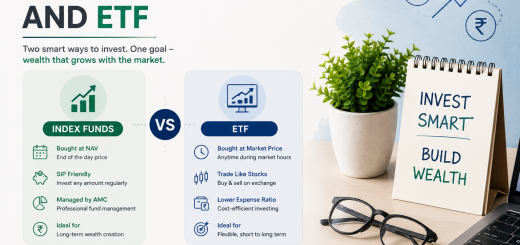
index funds are a type of mutual fund. they track a market index like the nifty 50 or sensex. the fund holds the same stocks as the index, in the same proportion. there is no fund manager picking stocks. the goal is to match the index, not beat it .
for beginners, this is the simplest way to start investing in equities. the process is straightforward. here is how it works.
what index funds offer
index funds are passive investments. they do not try to predict which stocks will perform well. they just follow the index.
low costs. expense ratios for index funds are significantly lower than actively managed funds . many index funds charge 0.1% to 0.5% annually. active funds often charge 1% to 2.5%.
no fund manager risk. the fund manager does not pick stocks. performance does not depend on a manager’s skill . if the manager leaves, the fund’s strategy does not change.
transparency. the portfolio is the index. investors know exactly what they own . no hidden bets. no surprise holdings.
diversification. one fund gives exposure to 50 or 100 companies across sectors . this reduces the risk of any single stock hurting the portfolio.
index funds have gained ground in india. passive aum grew nearly 8 times since 2020 . as of february 2026, index funds held ₹3.25 lakh crore in assets .
choose the index first, not the fund
most beginners look for the “best index fund.” a better approach is to choose the index first .
nifty 50. the 50 largest companies on the national stock exchange. stable, well-established businesses. suitable for beginners.
sensex. 30 of the largest and most liquid companies on the bombay stock exchange. similar to nifty 50 in risk and return.
nifty next 50. companies ranked 51-100 by market cap. higher growth potential. higher volatility .
nifty 100 or 500. broader market exposure. includes mid-cap and small-cap stocks. more volatile .
for a first-time investor, a nifty 50 or sensex index fund is often the starting point.
choose the fund, then the investment mode
once the index is chosen, compare funds tracking that index.
tracking error. how closely the fund follows the index. lower is better . a fund with high tracking error will not deliver the index return.
expense ratio. the annual fee charged by the fund. lower is better . even a 0.2% difference compounds over time.
aum (assets under management). larger funds are more stable and handle redemptions better .
once the fund is selected, decide between sip and lump sum.
systematic investment plan (sip). invest a fixed amount regularly. monthly is the most common frequency. minimum sip amounts start from ₹500 or ₹100 . sip removes the need to time the market. it buys more units when prices are low and fewer when prices are high . this is rupee-cost averaging.
lump sum. invest a larger amount at one time. this works when surplus cash is available. it requires comfort with market timing.
how to start
step 1: complete kyc. pan, aadhaar, and address proof are required. most platforms allow e-kyc online .
step 2: choose a platform. mutual fund platforms like kuvera, groww, paytm money, and et money offer index funds. direct plans have lower expense ratios .
step 3: select the fund. search for the index fund tracking the chosen index. compare tracking error and expense ratio.
step 4: start the sip or lump sum. enter the amount and complete the payment .
step 5: review periodically. check the fund’s tracking performance once a year. adjustments are rarely needed .
index funds vs etfs. the difference
index funds and etfs both track indices. but they work differently.
index funds. bought directly from the fund house or platform. transacted at end-of-day nav. no demat account is required. sip is available .
etfs. traded on the stock exchange like shares. require a demat and trading account. prices change throughout the day . sip is not available for etfs .
for most beginners, index funds are simpler than etfs . there is no need to track bid-ask spreads or intraday prices .
taxation
index funds are equity-oriented funds.
ltcg. held for more than 12 months. gains above ₹1.25 lakh are taxed at 12.5% .
stcg. held for up to 12 months. gains are taxed at 20% .
frequently asked questions
1. can index funds lose money?
yes. index funds are market-linked. if the index falls, the fund falls. they are not guaranteed.
2. what is the minimum sip amount for index funds?
most index funds accept sips starting from ₹500. some allow ₹100.
3. do index funds require a demat account?
no. index funds are mutual funds. they can be bought directly from fund houses or platforms. only etfs require a demat account .
4. which index fund is best for beginners?
a nifty 50 or sensex index fund is often recommended. these funds track large, established companies. they are less volatile than mid-cap or small-cap indices .
5. are index funds better than active funds?
not always. index funds offer lower costs and simplicity. active funds may outperform in some market conditions. over long periods, many active funds fail to beat their benchmark after costs .