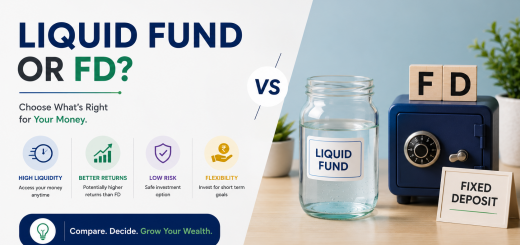
over a 6 to 12 month horizon, both liquid funds and fixed deposits serve similar purposes. safety. capital preservation. some return. the way they deliver these outcomes is different.
the choice is not about which is universally better. it is about which fits the specific need.
returns. what the numbers show
liquid funds have delivered returns between 6.3% and 6.9% over the past year. major banks currently offer fd rates of 6% to 7.25% for general depositors, depending on the bank and tenure .
axis liquid fund delivered 3.4% over the last six months and 6.4% over the last year . some banks offer 6.75% for a 444-day special tenure fd .
over a 12-month period, the difference is small. liquid funds have returned roughly 6.4% . bank fds offer 6.2% to 7.25% for 1-year tenures . the ranges overlap significantly.
the key difference is not the number. it is what happens after the period ends .
liquidity. where the difference shows
liquid funds offer t+1 redemption. the money is available the next business day. some funds offer instant redemption up to specified limits. no lock-in. no penalty for early withdrawal after the first 7 days .
fixed deposits lock the money for the chosen tenure. early withdrawal means a penalty of 0.5% to 1% on the interest rate. the effective return drops .
for a clearly defined 6 to 12 month goal, this may not matter. the money is not needed until maturity. but if the timeline is uncertain, liquid funds provide flexibility without cost .
tax treatment. timing matters
both are now taxed at the investor’s slab rate for the most part. but the timing differs .
fd interest is taxed as it accrues. every year, the interest is added to income, even if not withdrawn. this reduces the compounding effect. tds is deducted if interest exceeds ₹40,000 in a year .
liquid fund gains are taxed only on redemption. the full amount continues to compound until withdrawal. for someone in a higher tax bracket, this deferral preserves more of the pre-tax amount .
side-by-side comparison
| factor | liquid funds | fixed deposits |
|---|---|---|
| returns | 6.3-6.9% (market-linked) | 6-7.25% (guaranteed) |
| liquidity | t+1, no penalty after 7 days | penalty on premature withdrawal |
| tax | taxed on redemption | taxed as it accrues |
| certainty | variable | fixed |
which one for 6 to 12 months
for a fixed 6 to 12 month goal where the maturity date is certain, an fd with a competitive rate works. the return is guaranteed. the rate is locked .
for a 6 to 12 month period where the end date is uncertain, liquid funds offer more flexibility. the ability to redeem without penalty outweighs the small difference in return .
a combination is also practical. park a portion in an fd for the guaranteed return. keep the rest in a liquid fund for flexibility .
sweep-in fds offer an intermediate option. they link a savings account to a fixed deposit. surplus money earns fd rates. withdrawals are automatic. for money needed within a week, sweep-in fds work well. for money parked for around three months, liquid funds begin to look more attractive .
frequently asked questions
1. which gives higher returns over 6 months
returns are similar. axis liquid fund delivered 3.4% over the last 6 months . banks offer 6.25-6.75% annualised for 6-12 month tenures, which translates to roughly 3.1-3.4% for six months .
2. can a liquid fund be withdrawn before 6 months
yes. no lock-in. no penalty after the first 7 days .
3. is fd interest taxable every year
yes. the interest is added to income each year as it accrues, even if not withdrawn .
4. do liquid funds have exit load
some funds charge a graded exit load for redemptions within 7 days. zero after that .
5. which is safer for a 6-month goal
both are low risk. fds have deposit insurance up to ₹5 lakh. liquid funds have no guarantee but invest in high-quality short-term instruments .